For many South African students studying Analytical Chemistry or Biotechnology, there comes a moment that feels both exciting and stressful at the same time.
You have completed your theory. You have passed your modules. You are close to finishing your qualification.
But then reality hits.
You still need in-service training.
And finding that opportunity can feel harder than the qualification itself.
Some students apply for months without success. Others accept placements that do not align with their field just to complete the requirement. The pressure builds quickly because without in-service training, graduation is delayed.
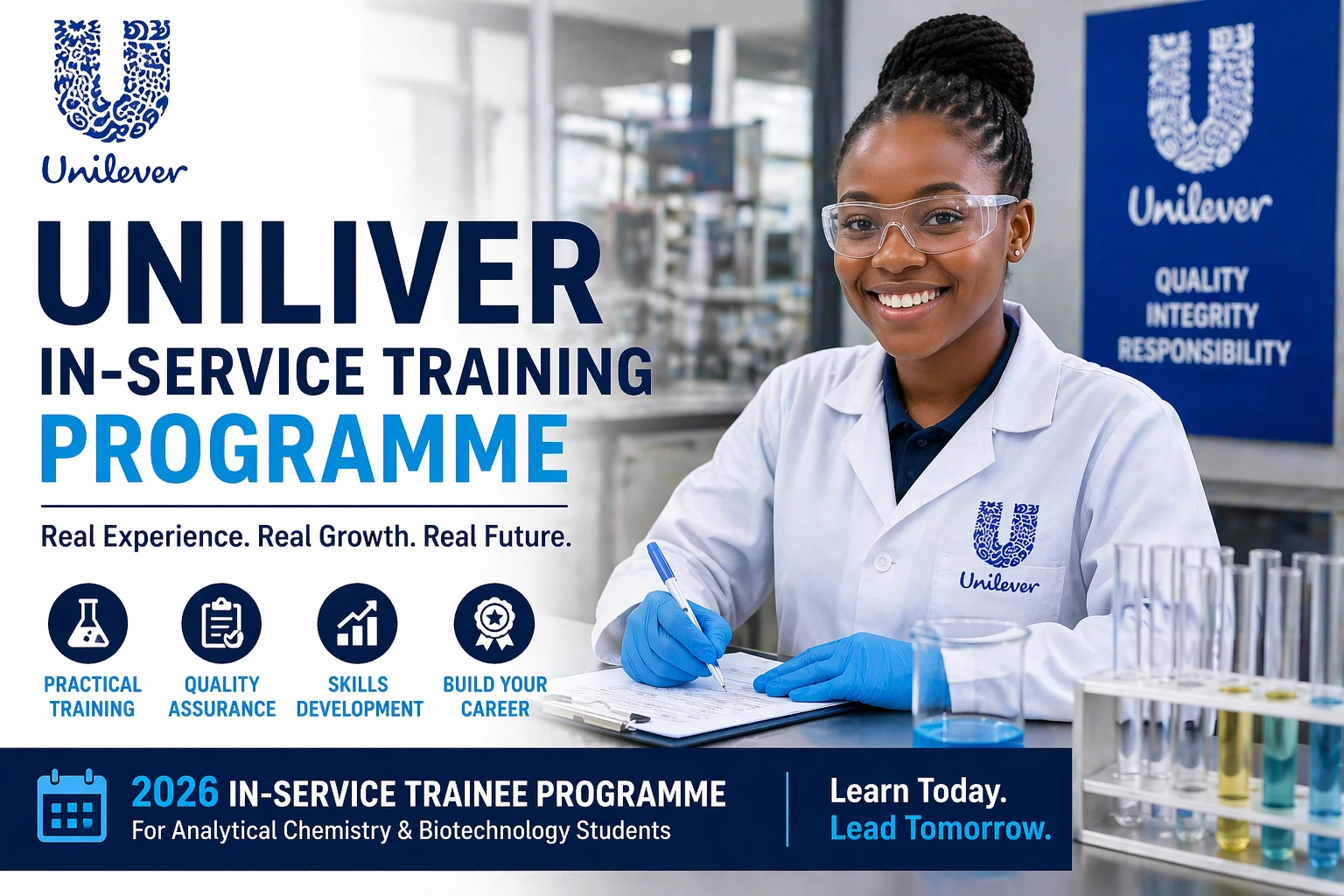
This is exactly why structured programmes like the Unilever In-Service Trainee Quality Programme for 2026 stand out.
It is not just another training opportunity. It is a direct pathway into a real working environment where your qualification starts to become a career.
Why In-Service Training Has Become More Competitive in South Africa
In recent years, more students have entered science and technical fields, but workplace opportunities have not increased at the same pace.
According to Statistics South Africa, youth unemployment remains a serious challenge, particularly among graduates who lack practical experience. You can explore detailed labour data directly from the official Statistics South Africa website:
https://www.statssa.gov.za
This creates a difficult situation where even qualified students struggle to secure placements.
At the same time, employers are becoming more selective. They are not just looking for academic results. They want candidates who understand real-world systems, processes, and responsibilities.
That is why in-service training is no longer just a requirement.
It is a competitive advantage.
What the Unilever Trainee Programme Is Really Offering
The Unilever In-Service Trainee Quality Programme is designed for students who need one year of practical training to complete their qualification.
It is a full-time, on-site role within a structured production and quality environment.
This means you are not observing. You are contributing.
Trainees are involved in:
quality assurance processes
product evaluation and testing
complaint investigations
data analysis and reporting
continuous improvement initiatives
What makes this valuable is not just the exposure. It is the level of responsibility.
In highly regulated environments, organisations often follow global standards such as those set by the International Organization for Standardization, which emphasise strict quality control to ensure product safety and consistency. Learn more about ISO standards here:
https://www.iso.org
The Reality Most Students Don’t Expect
Many students assume in-service training will be a smooth transition from theory to practice.
It is not.
Working in a quality environment means:
constant attention to detail
strict adherence to procedures
accountability for accuracy
responsibility for outcomes
In the first few weeks, it can feel overwhelming.
You may be analysing product samples, comparing them to strict standards, and documenting results while learning new systems at the same time.
This adjustment phase is where most growth happens.
What You Will Actually Be Doing in the Role
This programme offers hands-on exposure across multiple areas of quality assurance.
Your responsibilities may include:
investigating product defects and compiling reports
evaluating products through sensory testing
comparing complaint samples with retained stock
recording and analysing quality data
supporting continuous improvement processes
You may also work with systems like SAP, which are widely used in industry.
This is not classroom learning.
It is real, applied experience.
The Skills That Will Set You Apart in the Job Market
By the end of the programme, you develop more than technical knowledge.
You gain:
analytical thinking
attention to detail
problem-solving ability
professional communication
confidence in structured environments
According to the South African Qualifications Authority, workplace-based learning programmes are aligned with recognised qualifications and significantly improve employability. You can explore qualification frameworks directly here:
https://www.saqa.org.za
These are the exact qualities employers are looking for in today’s job market.
Why Most Students Struggle to Secure Opportunities Like This
Many applicants assume meeting the academic requirements is enough.
It is not.
Employers also look for:
willingness to learn
consistency and reliability
attention to detail
ability to work in structured environments
Common mistakes include:
submitting generic CVs
missing required documents
not understanding the role
This is often why strong candidates are overlooked.
Who Should Apply for This Programme
This opportunity is designed for students who:
have Matric with Mathematics and Physical Science
are completing or have completed S4 in Analytical Chemistry or Biotechnology
require one year of in-service training
You do not need experience.
But you do need discipline, focus, and a willingness to learn.
What You Need to Prepare Before Applying
Applicants should prepare:
Matric Certificate
Academic Transcript
Proof of qualification or results
Updated CV
Incomplete applications are often rejected immediately, which is why attention to detail matters even before you are hired.
Important Considerations Before You Apply
This is a fully on-site role
A monthly stipend is provided
No relocation support is included
You must be eligible to work in South Africa
Planning ahead is essential, especially if the workplace is far from your home.
Why This Opportunity Matters More in 2026
The job market is becoming more competitive.
At the same time, both employers and platforms like Google Discover are prioritising real, experience-driven value over generic information.
This reflects a broader shift.
Employers are no longer looking for candidates who simply meet requirements.
They want individuals who:
understand real environments
have practical exposure
can contribute from day one
That is why programmes like this matter more now than ever.
Where This Programme Can Take You
This experience can lead to roles such as:
quality assurance technician
laboratory analyst
production quality controller
data and reporting roles
With time and experience, you can move into:
quality management
operations leadership
specialised technical roles
The key is to treat this as a starting point.
Click here: https://dailyseta.co.za/category/youth-learnerships/
How to Approach This Opportunity Strategically
To stand out:
tailor your CV to match the role
highlight both academic and practical experience
demonstrate attention to detail
show willingness to learn
Employers are not just selecting qualifications.
They are selecting mindset.
Final Thoughts
The Unilever In-Service Trainee Quality Programme for 2026 is more than a graduation requirement.
It is a chance to gain real-world experience in a structured, professional environment.
For students in Analytical Chemistry or Biotechnology, it offers exposure to systems, processes, and responsibilities that shape long-term careers.
In a competitive job market, progress often starts with a single opportunity.
This could be that opportunity.
And sometimes, that first step is all it takes to change your direction completely.
Explore more opportunities: https://dailyseta.co.za/
What is the Unilever In-Service Training Programme?
The Unilever In-Service Training Programme is a structured workplace training opportunity designed for students in Analytical Chemistry or Biotechnology who need practical experience to complete their qualifications. It provides hands-on exposure to quality assurance, product testing, and real factory processes within a professional environment.
Who can apply for the Unilever trainee programme?
The programme is open to South African students who have completed Matric with Mathematics and Physical Science and are currently completing or have completed their S4 qualification in Analytical Chemistry or Biotechnology. Applicants must require in-service training as part of their studies.
Does the Unilever in-service training programme offer a stipend?
Yes, selected candidates usually receive a monthly stipend during the programme. This helps cover basic expenses such as transport and meals. However, it is important to note that relocation costs are typically not covered.
What kind of experience will I gain during the programme?
Participants gain practical experience in quality assurance, product evaluation, complaint investigations, data analysis, and reporting. They may also work with systems used in industry, which helps prepare them for full-time roles in manufacturing, laboratory, or quality control environments.
What happens after completing the programme?
After completing the programme, you will have real workplace experience and improved employability. This can lead to opportunities such as quality assurance technician, laboratory analyst, or production roles. Some candidates may also be considered for permanent positions depending on performance and business needs.

Nonhlanhla Nohiya is a dedicated South African career development writer and SETA-focused research specialist, best known as the voice behind Daily SETA. With a strong passion for youth empowerment and skills development, she has positioned herself as a trusted guide for learners, job seekers, and graduates navigating the complex landscape of Sector Education and Training Authorities (SETAs).
With years of hands-on research and content development experience, Nonhlanhla specializes in identifying verified learnerships, internships, and bursary opportunities across multiple industries—including business administration, IT, banking, and technical trades. Her work is rooted in simplifying access to SETA-accredited programmes, ensuring that readers not only find opportunities but understand how to qualify, apply, and succeed.
Authority & Expertise
SETA System Knowledge: Deep understanding of South Africa’s SETA framework, funding structures, and accreditation processes
Opportunity Curation: Tracks and verifies hundreds of active learnerships, internships, and bursaries annually
Career Guidance: Provides practical, step-by-step application advice including CV writing, document preparation, and interview readiness
Industry Insight: Covers emerging fields such as Artificial Intelligence, Cybersecurity, and Technical Support pathways within SETA programmes
Experience & Impact
Nonhlanhla has helped thousands of young South Africans access workplace-based learning opportunities by delivering accurate, up-to-date, and actionable information. Her content consistently highlights:
Real stipend ranges (R3,500 – R5,000+)
Entry requirements (Grade 10–12 and beyond)
Programme expectations and learner rights
Through her work, she actively contributes to bridging the gap between education and employment, particularly for underserved communities.
Mission
Her mission is simple yet powerful:To make career opportunities accessible, understandable, and achievable for every South African youth.