You applied for the job.
Then another one.
And another one.
At first, you were hopeful. Then patient. Then confused.
Now you’re frustrated.
Because no matter how many applications you send, nothing seems to happen.
No calls. No feedback. Just silence.
If this sounds familiar, you are not alone. And the truth is, it is not always about a lack of opportunities.
In many cases, the problem starts with one thing.
Your CV.
The Reality Most Job Seekers Don’t Want to Hear
Recruiters do not read your CV the way you think they do.
They scan it.
Research shows that recruiters spend only about 6 to 7 seconds reviewing a CV before deciding whether to continue or move on
That means your CV has a very small window to make an impression.
If it is unclear, generic, or difficult to read, it will likely be ignored — no matter how qualified you are.
This is not about being unfair.
It is about how hiring works.
Why Most CVs Fail Before They Are Even Read
Here’s what many job seekers don’t realise.
Your CV is not being judged on effort.
It is being judged on relevance.
Many people include everything they have ever done, hoping something will stand out. But this often creates confusion instead of clarity.
Recruiters are scanning for quick alignment with the role, not your entire history
If they cannot find that alignment quickly, they move on.
The Hidden Reason Your CV Is Getting Ignored
Your CV is not written for the employer.
It is written about you.
Most CVs focus on:
- Responsibilities
- Personal history
- Generic skills
But employers are asking a different question:
👉 “What can this person do for us right now?”
Until your CV answers that clearly, it will struggle to get attention.
What Recruiters Look for in the First Few Seconds
When scanning your CV, recruiters focus on a few key things:
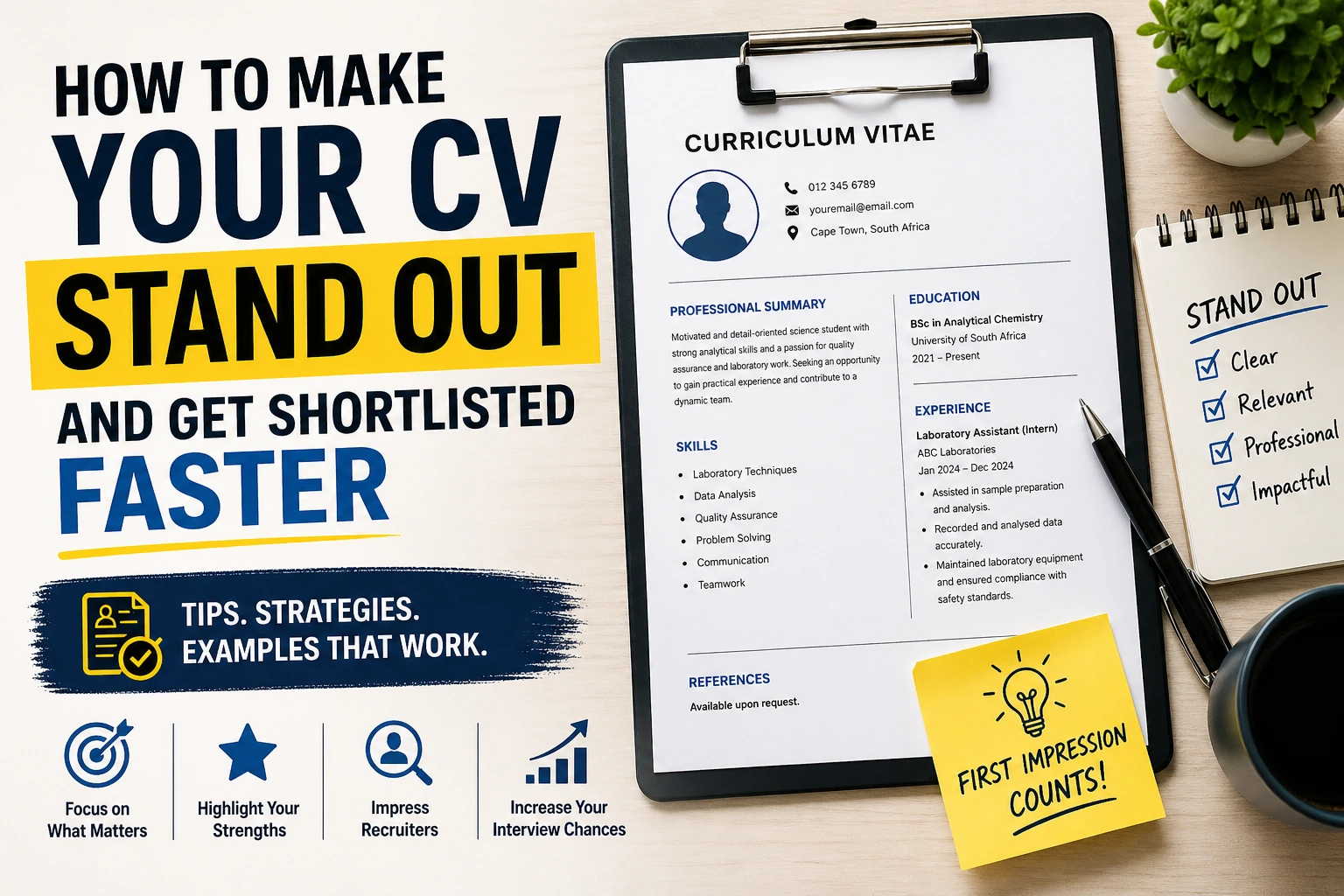
Clear structure and formatting
Relevant experience
Skills that match the job
Education requirements
Studies show recruiters follow a scanning pattern, focusing on job titles, experience, and education first
That is why your most important information must be easy to find immediately.
Visit: https://dailyseta.co.za/
Tip 1: Start With a Strong CV Summary
Your CV summary is your first impression.
Make it clear and direct.
Example:
A motivated Analytical Chemistry student seeking in-service training to gain practical experience in quality assurance and laboratory analysis.
Avoid vague phrases like:
Hardworking individual looking for opportunities
Be specific.
Tip 2: Tailor Your CV for Every Application
Sending the same CV to every job is one of the biggest mistakes.
Recruiters and even automated systems (ATS) filter CVs based on relevance and keywords
Before applying:
Read the job description carefully
Identify key requirements
Adjust your CV to match
This increases your chances of being shortlisted.
Tip 3: Show Skills With Real Examples
Anyone can list skills.
What matters is proof.
Instead of:
Good communication skills
Say:
Presented group research findings and collaborated with team members to complete projects successfully
This builds credibility.
Tip 4: Use Your Education as a Strength
If you are a student or graduate, your education matters.
Expand on it.
Include:
Relevant subjects
Projects
Practical work
According to South African Qualifications Authority, workplace-aligned learning improves employability by connecting theory with real-world skills.
You can explore qualification frameworks here:
https://www.saqa.org.za
Tip 5: Keep Your CV Simple and Easy to Read
A cluttered CV is one of the fastest ways to get rejected.
Use:
Clear headings
Bullet points
Short sentences
Research shows that simple layouts perform better because they are easier to scan quickly
Tip 6: Use Action Words That Show Confidence
The way you describe your experience matters.
Instead of:
Responsible for assisting customers
Say:
Assisted customers by providing product information and resolving queries
This sounds stronger and more professional.
Tip 7: Include Experience — Even If It’s Not Formal
You do not need a full-time job to have experience.
You can include:
School projects
Volunteering
Part-time work
Internships
What matters is showing what you did and what you learned.
Tip 8: Avoid Mistakes That Instantly Get You Rejected
Some mistakes can cost you opportunities immediately.
These include:
Spelling and grammar errors
Wrong contact details
Unprofessional email addresses
Too much irrelevant information
Always review your CV before submitting it.
Tip 9: Keep It Short and Relevant
A CV does not need to be long to be effective.
Recruiters prefer concise CVs that get straight to the point.
Focus on:
Relevant information
Clear structure
One to two pages maximum
Tip 10: Think Like a Recruiter
Before sending your CV, ask yourself:
Would I shortlist this person?
If the answer is unclear, improve your CV until it becomes obvious.
What Makes a CV Stand Out in 2026
The job market is changing.
Employers are now looking for:
Practical thinking
Adaptability
Real-world understanding
Willingness to learn
Your CV should reflect these qualities.
Even without experience, showing potential can make a strong impression.
Read and apply: https://dailyseta.co.za/uniliver-in-service-training-programme/
Key Takeaways
Your CV must be clear and easy to read
Focus on relevance, not quantity
Tailor your CV for each job
Show skills with real examples
Avoid common mistakes
Keep it professional and concise
Final Thoughts
Getting shortlisted is not about being perfect.
It is about being clear, relevant, and intentional.
Your CV is your introduction.
And in a competitive job market, how you introduce yourself can determine what happens next.
If your CV is not getting responses, do not assume you are not qualified.
Sometimes, the problem is not what you have done.
It is how you are presenting it.
Fix that — and everything can start to change.
How can I make my CV stand out with no experience?
Even without formal work experience, you can still make your CV stand out by highlighting skills gained from school projects, volunteering, or part-time work. Focus on what you did, what you learned, and how it applies to the job. Employers value potential, attitude, and willingness to learn just as much as experience.
How long should a CV be for entry-level job seekers?
For most entry-level candidates, a CV should be one to two pages long. It should include only relevant information, be easy to read, and clearly highlight your skills, education, and any practical experience. Keeping it concise helps recruiters quickly find what they are looking for.
What do recruiters look for first in a CV?
Recruiters usually look for a clear structure, relevant skills, and whether you meet the job requirements. They often scan the CV in a few seconds, so your most important information should be easy to find at the top of the page.
Should I use the same CV for every job application?
No, you should tailor your CV for each job application. Adjust your skills, experience, and summary to match the job description. This increases your chances of passing screening systems and getting shortlisted.
What are the most common mistakes to avoid on a CV?
Common mistakes include spelling and grammar errors, incorrect contact details, using an unprofessional email address, and including irrelevant information. These mistakes can reduce your chances of being shortlisted, so always review your CV before submitting it.

Nonhlanhla Nohiya is a dedicated South African career development writer and SETA-focused research specialist, best known as the voice behind Daily SETA. With a strong passion for youth empowerment and skills development, she has positioned herself as a trusted guide for learners, job seekers, and graduates navigating the complex landscape of Sector Education and Training Authorities (SETAs).
With years of hands-on research and content development experience, Nonhlanhla specializes in identifying verified learnerships, internships, and bursary opportunities across multiple industries—including business administration, IT, banking, and technical trades. Her work is rooted in simplifying access to SETA-accredited programmes, ensuring that readers not only find opportunities but understand how to qualify, apply, and succeed.
Authority & Expertise
SETA System Knowledge: Deep understanding of South Africa’s SETA framework, funding structures, and accreditation processes
Opportunity Curation: Tracks and verifies hundreds of active learnerships, internships, and bursaries annually
Career Guidance: Provides practical, step-by-step application advice including CV writing, document preparation, and interview readiness
Industry Insight: Covers emerging fields such as Artificial Intelligence, Cybersecurity, and Technical Support pathways within SETA programmes
Experience & Impact
Nonhlanhla has helped thousands of young South Africans access workplace-based learning opportunities by delivering accurate, up-to-date, and actionable information. Her content consistently highlights:
Real stipend ranges (R3,500 – R5,000+)
Entry requirements (Grade 10–12 and beyond)
Programme expectations and learner rights
Through her work, she actively contributes to bridging the gap between education and employment, particularly for underserved communities.
Mission
Her mission is simple yet powerful:To make career opportunities accessible, understandable, and achievable for every South African youth.