In South Africa today, thousands of young people are searching for work that feels meaningful—not just something to earn money, but something that truly makes a difference.
For many, that calling is childcare.
It’s a natural instinct. The ability to connect with children, to guide them, to protect them, and to help them grow. But as powerful as that passion is, it often comes with one big challenge:
Where do you even start?
You might have asked yourself:
- Do I need a qualification?
- Is experience more important?
- Which course should I choose?
And somewhere between all those questions, it becomes overwhelming.
That’s exactly why guidance from organisations like HWSETA is so important—it brings clarity to a path that often feels confusing.
If you’ve been feeling stuck, unsure, or even discouraged, this guide will walk you through a realistic, step-by-step way to start your childcare career in South Africa in 2026.
Why Childcare Is Becoming One of the Most Important Careers in South Africa
Let’s take a moment to look at the bigger picture.
South Africa continues to face high youth unemployment. At the same time, there is growing awareness around early childhood development (ECD) and how critical it is in shaping a child’s future.
According to the Department of Basic Education, early childhood support plays a major role in improving long-term educational outcomes.
That means trained childcare workers are not just needed—they are essential.
This is no longer just a “nice” career path.
It’s a purpose-driven profession with real impact.
The Truth Most People Don’t Tell You About Starting in Childcare
Here’s where many people get stuck.
They think:
“I love working with children, so I’ll just apply for jobs.”
But the reality is different.
Most employers are looking for:
- Basic qualifications
- Understanding of child development
- Some form of structured training
This doesn’t mean you need years of study.
But it does mean you need the right starting point.
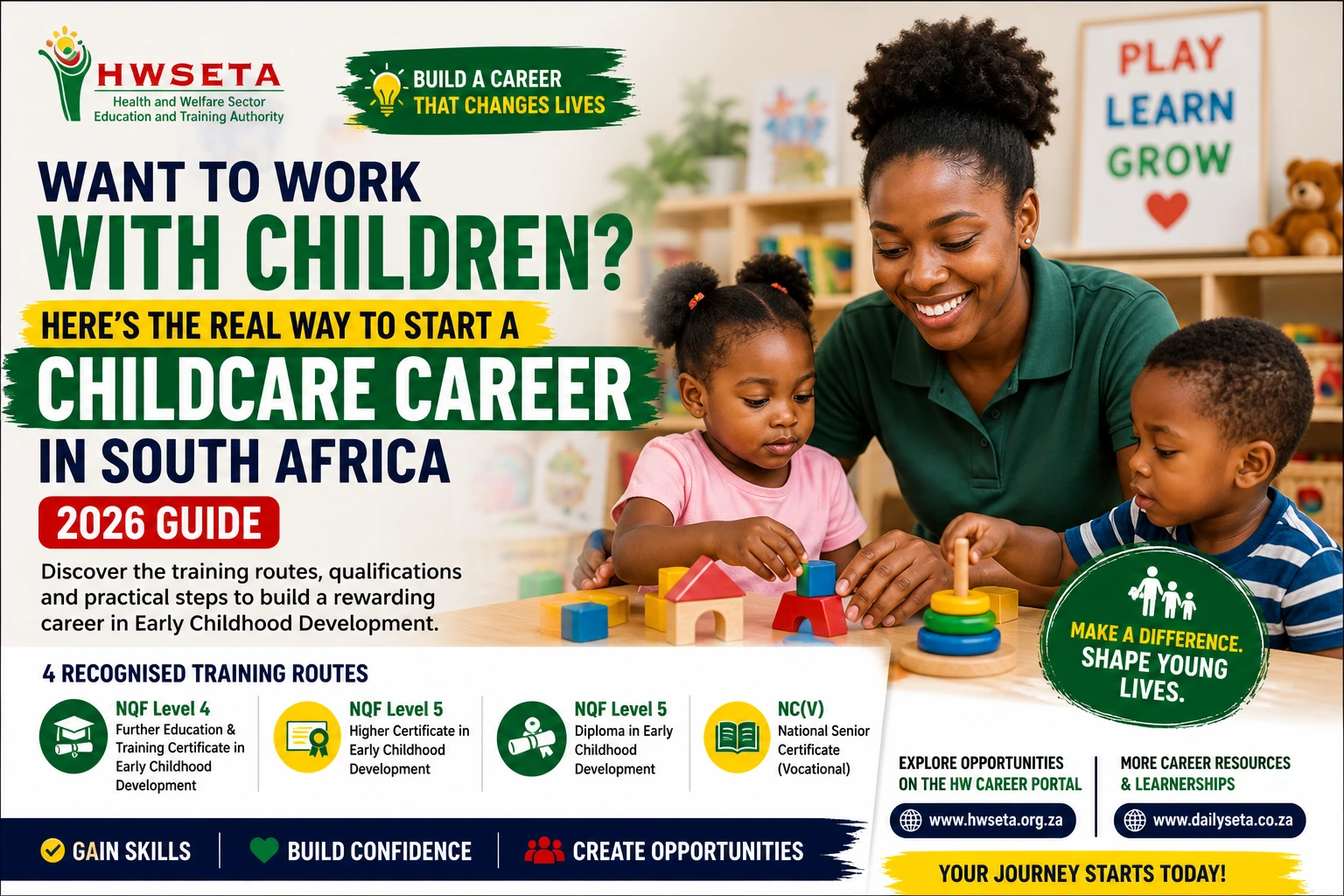
The 4 Recognised Study Paths (And How to Choose the Right One)
One of the most helpful things HWSETA has done is clearly outline four recognised pathways into childcare.
This removes the guesswork.
Let’s break them down in a way that actually helps you decide.
1. NQF Level 4: The Smart Starting Point
If you are just beginning, this is often the best place to start.
It’s practical, accessible, and designed to help you:
- Understand child development basics
- Build confidence
- Enter the childcare space faster
👉 You can verify qualification levels through the South African Qualifications Authority
This route is ideal if:
- You’ve completed matric
- You have no prior childcare training
- You want to start working as soon as possible
2. NQF Level 5: Building Deeper Knowledge
If you meet the requirements, this level helps you:
- Gain more structured knowledge
- Improve your professional standing
- Access better opportunities
It’s a step forward—but only if you’re ready for it.
3. Diploma in Early Childhood Development
This is for those thinking long-term.
It can lead to:
- Leadership roles
- Managing childcare centres
- Advanced teaching support
But here’s the key insight:
👉 Don’t rush into this level if you’re not ready.
4. NC(V): A Practical Alternative Route
This vocational pathway combines:
- Classroom learning
- Hands-on experience
It’s especially useful for school leavers who want a career-focused education route.
How to Choose the Right Path (This Decision Matters More Than You Think)
This is where many people make a mistake.
They choose the highest qualification—thinking it will impress employers.
But employers don’t just want qualifications.
They want:
- Practical ability
- Confidence
- Real understanding
The smartest choice is the one that:
- Matches your current level
- Gets you into real childcare environments sooner
- Builds experience step by step
Sometimes, starting small is the fastest way forward.
Also apply for: https://dailyseta.co.za/sa-youth-teacher-assistant-programme/
What You’ll Actually Learn (Beyond the Certificate)
Childcare training is not just about passing exams.
It’s about becoming someone children can rely on.
You’ll learn how to:
- Understand how children grow and develop
- Communicate effectively with young learners
- Create safe and structured environments
- Support emotional and social development
- Encourage learning through play
This is where passion becomes professional skill.
Where to Find Real Opportunities (Trusted Platforms Only)
Once you understand your path, the next step is action.
Here are trusted platforms to explore:
🔗 HWSETA Career Portal
https://www.hwseta.org.za
🔗 Department of Employment and Labour
https://www.labour.gov.za
🔗 Daily Seta (latest learnerships & guidance)
https://dailyseta.co.za
These platforms regularly update opportunities—but here’s the truth:
⚠️ Many opportunities close quickly once enough applications are received.
That’s why preparation matters.
What You Need Before Opportunities Open
This is where many people fall behind.
They wait until an opportunity appears—then rush to prepare.
Instead, get ready now.
Have these ready:
- Updated CV
- Certified ID
- Academic results
- Working email and phone number
When the right opportunity appears, you’ll be ready to act immediately.
What Kind of Person Succeeds in Childcare?
Let’s move beyond qualifications.
This career requires something deeper.
You are likely a strong fit if you:
- Are patient
- Can stay calm under pressure
- Care about people
- Are willing to learn
- Can handle responsibility
Because at the end of the day, this work is about people—not paperwork.
The Reality Check: What This Career Demands
Let’s be honest.
Childcare is rewarding—but it’s not always easy.
There will be:
- Long days
- Emotional moments
- Situations that test your patience
But there will also be:
- Growth
- Impact
- A sense of purpose
And for many people, that trade-off is worth it.
Common Mistakes That Keep People Stuck
If you’ve been trying to move forward but feel stuck, one of these might be the reason:
- Waiting for the “perfect” opportunity
- Not understanding qualification pathways
- Applying without preparation
- Ignoring entry-level routes
Progress doesn’t come from waiting.
It comes from starting, even when things aren’t perfect.
A Simple Step-by-Step Plan You Can Follow Today
If you’re serious about becoming a childcare worker, start here:
- Identify your current qualification level
- Choose the most suitable ECD pathway
- Prepare your documents
- Monitor trusted platforms weekly
- Apply consistently
Small actions, repeated over time, create real change.
Is This Career Worth It in 2026?
If you’re looking for:
- Purpose
- Stability
- A people-centered career
Then yes—this is one of the most meaningful paths you can choose.
And in South Africa today, where early childhood development is gaining more attention, this field is only becoming more important.
Final Thought: You Don’t Need to Have Everything Figured Out
One of the biggest reasons people don’t start is because they feel unprepared.
But the truth is:
You don’t need to have everything figured out.
You just need to take the first step.
HWSETA has already made that easier by showing that there are clear, recognised pathways into childcare.
Now the next move is yours.
Start where you are.
Choose what fits you.
Take action—even if it feels small.
Because the difference between staying stuck and moving forward often comes down to one decision:
Starting today.
Visit: https://dailyseta.co.za/
How do I start a career in childcare in South Africa?
To start a career in childcare in South Africa, you need to complete an Early Childhood Development (ECD) qualification such as an NQF Level 4 certificate. After that, you can gain practical experience through internships, learnerships, or entry-level roles at crèches, preschools, or daycare centres.
What qualifications do I need to work with children in South Africa?
Most childcare roles require an ECD qualification. The common options include a Further Education and Training Certificate (NQF Level 4), a Higher Certificate (NQF Level 5), or a Diploma in Early Childhood Development. The right qualification depends on your current education level and career goals.
Can I become a childcare worker without experience?
Yes, you can start without experience, but you will need basic training in Early Childhood Development. Many programmes are designed for beginners and include practical components to help you gain hands-on experience while learning.
Where can I apply for childcare training or learnerships in South Africa?
You can apply for childcare training and learnerships through official platforms such as the Health and Welfare Sector Education and Training Authority portal, the Department of Employment and Labour website, and career platforms like Daily Seta, which regularly list opportunities and guidance for job seekers.
Is childcare a good career choice in South Africa in 2026?
Yes, childcare is becoming a strong and meaningful career path in South Africa. With increasing focus on early childhood development, there is growing demand for trained childcare workers. It offers opportunities for personal growth, job stability, and the chance to make a positive impact on children’s lives.

Nonhlanhla Nohiya is a dedicated South African career development writer and SETA-focused research specialist, best known as the voice behind Daily SETA. With a strong passion for youth empowerment and skills development, she has positioned herself as a trusted guide for learners, job seekers, and graduates navigating the complex landscape of Sector Education and Training Authorities (SETAs).
With years of hands-on research and content development experience, Nonhlanhla specializes in identifying verified learnerships, internships, and bursary opportunities across multiple industries—including business administration, IT, banking, and technical trades. Her work is rooted in simplifying access to SETA-accredited programmes, ensuring that readers not only find opportunities but understand how to qualify, apply, and succeed.
Authority & Expertise
SETA System Knowledge: Deep understanding of South Africa’s SETA framework, funding structures, and accreditation processes
Opportunity Curation: Tracks and verifies hundreds of active learnerships, internships, and bursaries annually
Career Guidance: Provides practical, step-by-step application advice including CV writing, document preparation, and interview readiness
Industry Insight: Covers emerging fields such as Artificial Intelligence, Cybersecurity, and Technical Support pathways within SETA programmes
Experience & Impact
Nonhlanhla has helped thousands of young South Africans access workplace-based learning opportunities by delivering accurate, up-to-date, and actionable information. Her content consistently highlights:
Real stipend ranges (R3,500 – R5,000+)
Entry requirements (Grade 10–12 and beyond)
Programme expectations and learner rights
Through her work, she actively contributes to bridging the gap between education and employment, particularly for underserved communities.
Mission
Her mission is simple yet powerful:To make career opportunities accessible, understandable, and achievable for every South African youth.